Quite a while back we had a guest lecture from John Wagland from BBFC (British Board of Film Classification). Here are my notes and what I personally thought of said talk.
First and foremost he explained that BBFC is non-government organisation which grades films and games. Local authorities can overrule the rating if wanted too. Everything that is on the blu-ray's or DVD's have to be rated through the BBFC to make sure nothing slips through, I have noticed this a few times when it says movie rated 15 but the DVD is rated 18 due to bonus content. Rating content on the DVD itself is a good idea I think as behind the scenes or extra pieces of film which may of been cut to bring down the rating before could appear on them.
The details of how many people work there have probably changed since he came and gave the talk but according to my notes there are 16 full time examiners, with various backgrounds and some obviously being able to speak foreign languages. There are 3 senior examiners too and these examiners are all split into 3 teams. Thought there would be more people as the amount of films they would have to watch must be staggering, I will touch on the amount of hours a day later on.
Duties for the examiners are obviously viewing the film, having meetings along with some team projects and pretty much the usual stuff. They have to watch over 5 1/2 hours per day of films, the order, this may seem cool to some and even as a movie buff it sounds like a decent job but the examiners log, post view guidelines and policies along with the reports to be done amoungst other things its does sound a bit harder.
BBFC don't just rate films as I said before they also rate some games. Just managed to find an example almost straight away as there is a copy of the new Mortal Kombat game rated 18 by the BBFC. When they rate the games they are given usually given game saves, level skips and the cheats, this makes the rating process quicker generally. The interaction element has to be taken into account as driving around smashing into building and shooting people in a game is different then watching it in a movie, well it is in my opinion anyway. Repetition of an event or of the same action is also a vital factor to remember when they rate games, sometimes there may only be 1-2 major blood scenes in a game rather than some which are completely filled from head to toe with blood and gore.
Here is a list of the stuff they look out for when rating films and games:
-Violence
-Foul/abusive language
-Sexual references
-Sex
-Sexual Violence
-Weapons
-Horror
-Offence
-Theme of the film/game
-Discrimination
-Drugs
-Story
-Audience
-Morals
-Artistic/educational
-Possible harm
-level of offensiveness
-Context
A long-ish list and im sure there are many more things they look out for but I only noted these down and I don't actually remember him saying any more. Obviously they should be fairly self explanatory for ratings when it comes to violence, sex drugs etc.. It is interesting to see what exactly they look out for and after having the lecture I seem more aware of the rating on games and movies. Personally the best lecture of the year for me as I am thoroughly interested in this sort of thing.
Thursday, 5 May 2011

Bibliography, bit late but hey its here! :P
Book items.
Braithwaite, B. & Schreiber, I., 2008. Challenges for Games Designers Non-Digital Exercises for Video Game Designers, Boston: Course Technology.
Trefry, G., 2010. Casual Game Design Designing Play for the Gamer in All of Us, Burlington: Morgan Kaufmann.
Contributions
Corneliussen, H.G., 2008. Digital Culture, Play and Identity A World of Warcraft Reader, Rettberg, Walker J. Cambridge (Mass.): MIT Press.
Wolf, M.J.P., 2003. The Video Game Theory Reader, Perron, Bernard,. London: Routledge.
Articles
Venturelli, M. 2009. Space of Possibility and Pacing in Casual Game Design: A PopCap Case Study. VIII Brazilian Symposium on Games and Digital Entertainment.
Anon, Playstation hack: timeline of huge security breach. Telegraph.co.uk. Available at: http://www.telegraph.co.uk/technology/sony/8495072/Playstation-hack-timeline-of-huge-security-breach.html [Accessed May 5, 2011].
Anon, Samsung to launch Chrome OS laptops at Google I/O. Telegraph.co.uk. Available at: http://www.telegraph.co.uk/technology/google/8493947/Samsung-to-launch-Chrome-OS-laptops-at-Google-IO.html [Accessed May 5, 2011].
I think these are all correct havn't really used Zotero too much before.
Braithwaite, B. & Schreiber, I., 2008. Challenges for Games Designers Non-Digital Exercises for Video Game Designers, Boston: Course Technology.
Trefry, G., 2010. Casual Game Design Designing Play for the Gamer in All of Us, Burlington: Morgan Kaufmann.
Contributions
Corneliussen, H.G., 2008. Digital Culture, Play and Identity A World of Warcraft Reader, Rettberg, Walker J. Cambridge (Mass.): MIT Press.
Wolf, M.J.P., 2003. The Video Game Theory Reader, Perron, Bernard,. London: Routledge.
Articles
Venturelli, M. 2009. Space of Possibility and Pacing in Casual Game Design: A PopCap Case Study. VIII Brazilian Symposium on Games and Digital Entertainment.
Anon, Playstation hack: timeline of huge security breach. Telegraph.co.uk. Available at: http://www.telegraph.co.uk/technology/sony/8495072/Playstation-hack-timeline-of-huge-security-breach.html [Accessed May 5, 2011].
Anon, Samsung to launch Chrome OS laptops at Google I/O. Telegraph.co.uk. Available at: http://www.telegraph.co.uk/technology/google/8493947/Samsung-to-launch-Chrome-OS-laptops-at-Google-IO.html [Accessed May 5, 2011].
I think these are all correct havn't really used Zotero too much before.
Wednesday, 4 May 2011
Formal abstract design tools notes
Doug Church’s article ‘Formal Abstract Design Tools’ is certainly one of the more helpful readings I have read this year. These are my notes regarding the article which has been expanded on and written up. Church talks about intention, story and perceivable consequence within the article, as well as some other stuff which I will cover too.
Firstly ‘intention’, in his words ‘Making an implementable plan of one's own creation in response to the current situation in the game world and one's understanding of the game play options.’ He describes intention within games as important tool to draw the player in along with perceivable consequence. Church sums up by saying when the player attempts a task and it fails they are likely to realise why they screwed it up.
Perceivable consequence follows up on this as it is used to show the player what the game would do if a certain action is performed, he says the feedback is generally visual e.g when you shoot your gun in Battlefield if you are pointing towards an enemy you know the game will react by killing the enemy once you press the button to shoot. Games which use this all the time wouldn’t be much fun just as Church said. Some outcomes need to be random or unknown in order for the player to be more involved, the example of ‘the player may decide to stay the night at an inn, and the next morning he may be ambushed. Now, it may be that the designers built this in the code or design of the game. ("We don't want people staying in town too much, so if they start staying at the inn too often, let's ambush them.") However, that causality is not perceivable by the player. While it may be an actual consequence, to the player it appears random.’ As he describes here designer may often include some outcome which are an actual consequence of the players actions but are completely unknown to the player therefore randomness is playing in the mind of the user. In role playing games players actions do not always have the same consequence as there are generally so many tasks and other things to do. This is common place within role playing games as it keeps the game fresh and is needed for the certain game genre.
Story is next on the list, This may seem obvious to be a main tool to use when making a game since a usually a good story makes a good game. Church talks about two methods of narrative one which is designer driven that binds events together in a certain sequence making the game linear, and the other player driven narrative which is when the story can change depending on the player actions within the game itself. When the story is well made and superbly done it as I said before lead to a fantastic game. When reading through my notes and the article itself again I was thinking about sandbox games and how these could be rendered under player driven stories if there is no actually story to them at first glance but the players makes a whole story up themselves. The Mount and Blade series is an example of this, in single player you are allowed to roam around capturing castles and slaying whoever you want. You can choose to make your own kingdom or join one already made, there is absolutely no story what so ever but it is so easy for imagination to set in and you target certain parties or do other stuff to flow with the story or your game.
Church at the start of the article explains some of the thinking behind making some games, he says designers often think if old ideas can be transformed into a 3d simulation and whether the game is actually going to be fun or not. As well as saying they don’t use words like fun or not fun they dissect the word and go into depth about what makes the game exciting for a certain range of people.
Overall this is an excellent article to read, and I thoroughly recommend anyone interested in games development to do so. I do understand I am crap at taking notes and writing up my ideas on an article but I hope this is ok :P It may be a bit old but I feel it can still relate to the current day.
Said article can be found here:
Doug Church, (1999), Formal Abstract Design Tools, Gamasutra
Firstly ‘intention’, in his words ‘Making an implementable plan of one's own creation in response to the current situation in the game world and one's understanding of the game play options.’ He describes intention within games as important tool to draw the player in along with perceivable consequence. Church sums up by saying when the player attempts a task and it fails they are likely to realise why they screwed it up.
Perceivable consequence follows up on this as it is used to show the player what the game would do if a certain action is performed, he says the feedback is generally visual e.g when you shoot your gun in Battlefield if you are pointing towards an enemy you know the game will react by killing the enemy once you press the button to shoot. Games which use this all the time wouldn’t be much fun just as Church said. Some outcomes need to be random or unknown in order for the player to be more involved, the example of ‘the player may decide to stay the night at an inn, and the next morning he may be ambushed. Now, it may be that the designers built this in the code or design of the game. ("We don't want people staying in town too much, so if they start staying at the inn too often, let's ambush them.") However, that causality is not perceivable by the player. While it may be an actual consequence, to the player it appears random.’ As he describes here designer may often include some outcome which are an actual consequence of the players actions but are completely unknown to the player therefore randomness is playing in the mind of the user. In role playing games players actions do not always have the same consequence as there are generally so many tasks and other things to do. This is common place within role playing games as it keeps the game fresh and is needed for the certain game genre.
Story is next on the list, This may seem obvious to be a main tool to use when making a game since a usually a good story makes a good game. Church talks about two methods of narrative one which is designer driven that binds events together in a certain sequence making the game linear, and the other player driven narrative which is when the story can change depending on the player actions within the game itself. When the story is well made and superbly done it as I said before lead to a fantastic game. When reading through my notes and the article itself again I was thinking about sandbox games and how these could be rendered under player driven stories if there is no actually story to them at first glance but the players makes a whole story up themselves. The Mount and Blade series is an example of this, in single player you are allowed to roam around capturing castles and slaying whoever you want. You can choose to make your own kingdom or join one already made, there is absolutely no story what so ever but it is so easy for imagination to set in and you target certain parties or do other stuff to flow with the story or your game.
Church at the start of the article explains some of the thinking behind making some games, he says designers often think if old ideas can be transformed into a 3d simulation and whether the game is actually going to be fun or not. As well as saying they don’t use words like fun or not fun they dissect the word and go into depth about what makes the game exciting for a certain range of people.
Overall this is an excellent article to read, and I thoroughly recommend anyone interested in games development to do so. I do understand I am crap at taking notes and writing up my ideas on an article but I hope this is ok :P It may be a bit old but I feel it can still relate to the current day.
Said article can be found here:
Doug Church, (1999), Formal Abstract Design Tools, Gamasutra
Issues faced when designing a Key Stage One game.
This is my essay for the 2nd assignment, just thought I would post it on here as I already have my draft on here too.
With particular reference to the readings you have undertaken this year what are the major design issues you have faced in developing a game for Key Stage 1 children
There are many ideas and methods I gathered from the earlier readings in the year to go forward with the key stage 1 game, for instance weather the game play mechanics are suitable for the sort of ‘fun’ a child would look for in an educational game and if it too easy that there is no struggle. I will go into depth on these along with some more readings which correspond with the struggles and design of our key stage 1 game. I will be using Greg Costikyan ‘I have no words I must design’ (2002), to reference about the design issues we faced along with Noah Falstein’s article called ‘Natural Funativity’ (2004)
Firstly the game we made had some constraints such as it being targeted towards key stage one children. When my particular concept of an archer shooting down balloons with letters in them to spell a word was put into where the design faze started and I thought it would be easy to create the game as I already had the idea but there were some major design issues which we came across. I will start off by looking at the Costikyan article where he writes about that Goals, structure, struggle and endogenous meaning. One of the many things he says in the article is ‘The structure, like the plot, is invented as needed – but kids do feel the need for structure, at times ’ (Costikyan, 2002) we took this and a lot of what he said about structure in the article to make sure we have a well-structured game, we decided that a decent structure backed up by an important story will be important for the game so that it becomes an enjoyable game which children would like to play rather than some of the educational games which can be lacking in uninteresting to some children of that age. The structure was going to be obvious from the outset and this problem was ironed out fairly quickly after some discussions over how it would be done. We decided on keeping it simple but try to keep the children entertained at the same time, so one item clicked and the bubbles coming down to spell the words was the final idea we went with along with background which should draw them into the game.
When Costikyan writes that Goals, structure, struggle and endogenous meaning are all needed when constructing a successful game we obviously took all the points into consideration. I have already spoken about the structural issue we faced so taking into account of the other points we did have some issues surrounding the goals of the game. The goal of the normal levels of the game was clear at first but after going into more detail with the coding we came across some simple things like how many words should be spelt in order to advance to the next level and others like I said before if the goal is actually achievable for children in the lower age bracket of Key Stage One. We had to come up with some answers to these problems and for the words we simply mixed them up so there are enough 3, 4 and 5 letter words on each level therefore hopefully allowing a child to spell a 3 or 4 letter world if they cannot spell the 5 letter word. Adding the variety in the words so children from 5-7 can all play the game was key as it’s designed to be for the whole of Key Stage One rather than just 5 or 7 year olds. The overall goal/final boss goal was to shoot the evil wizards name which in-turn ended up destroying him, his name would be jumbled up in bubbles floating around him. We wanted to have a climatic ending that made the game finish off on a high along with it being more on the game and fun side of things rather than just a flashing “Well Done for completing the game” at the end. For the child to have a slight change in game mechanic to avoid being bored of the same thing level after level was another aim for the boss level and final goal, at first we even wanted a simple mini boss to break up the game play too with the possible goal of having to knock him off a bridge. The mini boss goal would have been to knock him off a bridge into a lake or something which seemed child friendly; this would have the same goal of just scrapping the education side of things to break up game play as the mechanic would be changed just for one level. Time constraints however hindered the progress of these extra two levels, the mini boss was cut not too long into development as it just simply didn’t add too much in terms of how much work was need to put it in. The final boss was cut fairly near the end after some hiccups with the code, it did go from being still on for development to being scrapped quite a few times but about a month from the end as it just didn’t seem possible after some other bugs came up.
Seeing the two boss levels cut strengthened the cut scenes importance in order for the story to come across still. This didn’t cause too many problems apart from the script which was made slightly earlier in production being edited slightly to compensate for the bosses.
Struggle within the game was fairly important too as it was designed for Key Stage One children learning to spell. We didn’t want extremely easy words which they all knew as we thought it may bore the children getting the words spelt every time and it being an educational game we wanted to challenge them so they could perhaps learn a new word which is the goal of the game after all to teach children how to spell 3, 4 and 5 letter words just using the game medium as a method of doing so. The issue we faced with struggle was how to find some words which where a range from fairly easy to somewhat hard we think for a 5-7 year old. Being adults all over the age of 18 made this even harder, the thinking and research became incredibly important as we needed to get the correct item as the whole game depended on spelling and the children need to know what they are spelling. After many days of deliberation we started jotting down some words here and there trying to come up with some suitable ones, luckily we could test some of the words as another group member has a child at the age of 6 which was ideal. Once we heard this news thinking of some words became a bit harder as some of the suggestions seemed to be tricky. This is where the research came into play; we looked at similar spelling games which were aimed at the same age range to help with the sort of words which could be used.
Another issue we faced was the idea whether or not the child would actually find the game fun and enjoyable as we wanted to come up with something that didn’t feel like an educational game to play but in the end it was. In ‘Natural Funativity’ by Falstein he goes on to say under physical fun ‘Our primary urge is the survival instinct. Anything that directly threatens our survival automatically commands our full attention. It's not surprising that games, and in fact most of entertainment, use themes of survival to similarly capture the attention of players.’ (Costikyan, 2002) And under the heading mental fun he states ‘Even though we use our intelligence with physical and social fun, there is an entire set of entertainment activities including quite a few video games which focuses primarily on mental fun. We practice and improve our mental abilities in our leisure time just as we exercise our muscles and build social relationships’ – (Costikyan, 2002) The idea of having turning the concept of an archer shooting game which would come under the physical fun means the primeval instinct of shooting something and attacking, which seems to be more so in males into a mental challenge and mentally fun was a good idea. Mental fun is perfect in making the game a decent educational game that seems to be enjoyable at the same time, crossing physical and mental fun to make a game which rekindled some of the primeval instincts of fighting and those of mental challenges. Obviously being a children’s game we could have anything too dangerous or inappropriate so even something simple like when you click on the dog or a bird so you can spell the item an arrow doesn’t fire which may seem trivial but had to be done for a children’s game. Lots of issues about the game being suitable for children while still having some of the physical fun elements to it was thought about as no one had paid much attention to games of this sort before. This was probably was the biggest issue we had when designing the Key Stage One game as if it too dull or just not actually suitable for the children we would have failed. Reading into what Falstein said we decided to go along more of the mental route and keeping the physical fun to just the archer and some of the backgrounds in being adapted to that. Due to the game being a spelling game the mental fun is a big issue we decided on having 3-5 letter words because the research done had shown us they should be comfortably is able to spell those words. Having some 3 letter words and some 5 letter words in one stage was important for the fun too otherwise if a young Key Stage One child played the game and could only spell either 3 or 4 letter words that would be fine too.
In conclusion the articles we read throughout the year were a huge help in finding the solutions to some of the issues we faced, this may have been because it was the first proper game which we all worked on so some of the issues may be realised second time around. In particular though the Greg Costikyan article called ‘I Have No Words I Must Design’ was the biggest help in terms of games design in my eyes as it stated what successful games all have and what sort of things make up every day games. I felt the ‘Natural Funativity’ article was also a good read and help as I never thought of how fun the game concept was or if it would actually appeal to children. Luckily along with reading the other article from Costikyan we were able to figure out from our initial design if it was viable to make an education game which was actually fun as after we played some of the other education games they seemed just question based and to be frank fairly boring. We wanted to stray away from the traditional education game to make it fun as well as being educational so hopefully they would learn while they play.
Greg Costikyan, (2002), I Have No Words I Must Design, Costik
http://www.costik.com/nowords2002.pdf
Noah Falstein (2004) , Natural Funativity, - Gamasutra
http://www.gamasutra.com/view/feature/2160/natural_funativity.php
Wordcount 1919
With particular reference to the readings you have undertaken this year what are the major design issues you have faced in developing a game for Key Stage 1 children
There are many ideas and methods I gathered from the earlier readings in the year to go forward with the key stage 1 game, for instance weather the game play mechanics are suitable for the sort of ‘fun’ a child would look for in an educational game and if it too easy that there is no struggle. I will go into depth on these along with some more readings which correspond with the struggles and design of our key stage 1 game. I will be using Greg Costikyan ‘I have no words I must design’ (2002), to reference about the design issues we faced along with Noah Falstein’s article called ‘Natural Funativity’ (2004)
Firstly the game we made had some constraints such as it being targeted towards key stage one children. When my particular concept of an archer shooting down balloons with letters in them to spell a word was put into where the design faze started and I thought it would be easy to create the game as I already had the idea but there were some major design issues which we came across. I will start off by looking at the Costikyan article where he writes about that Goals, structure, struggle and endogenous meaning. One of the many things he says in the article is ‘The structure, like the plot, is invented as needed – but kids do feel the need for structure, at times ’ (Costikyan, 2002) we took this and a lot of what he said about structure in the article to make sure we have a well-structured game, we decided that a decent structure backed up by an important story will be important for the game so that it becomes an enjoyable game which children would like to play rather than some of the educational games which can be lacking in uninteresting to some children of that age. The structure was going to be obvious from the outset and this problem was ironed out fairly quickly after some discussions over how it would be done. We decided on keeping it simple but try to keep the children entertained at the same time, so one item clicked and the bubbles coming down to spell the words was the final idea we went with along with background which should draw them into the game.
When Costikyan writes that Goals, structure, struggle and endogenous meaning are all needed when constructing a successful game we obviously took all the points into consideration. I have already spoken about the structural issue we faced so taking into account of the other points we did have some issues surrounding the goals of the game. The goal of the normal levels of the game was clear at first but after going into more detail with the coding we came across some simple things like how many words should be spelt in order to advance to the next level and others like I said before if the goal is actually achievable for children in the lower age bracket of Key Stage One. We had to come up with some answers to these problems and for the words we simply mixed them up so there are enough 3, 4 and 5 letter words on each level therefore hopefully allowing a child to spell a 3 or 4 letter world if they cannot spell the 5 letter word. Adding the variety in the words so children from 5-7 can all play the game was key as it’s designed to be for the whole of Key Stage One rather than just 5 or 7 year olds. The overall goal/final boss goal was to shoot the evil wizards name which in-turn ended up destroying him, his name would be jumbled up in bubbles floating around him. We wanted to have a climatic ending that made the game finish off on a high along with it being more on the game and fun side of things rather than just a flashing “Well Done for completing the game” at the end. For the child to have a slight change in game mechanic to avoid being bored of the same thing level after level was another aim for the boss level and final goal, at first we even wanted a simple mini boss to break up the game play too with the possible goal of having to knock him off a bridge. The mini boss goal would have been to knock him off a bridge into a lake or something which seemed child friendly; this would have the same goal of just scrapping the education side of things to break up game play as the mechanic would be changed just for one level. Time constraints however hindered the progress of these extra two levels, the mini boss was cut not too long into development as it just simply didn’t add too much in terms of how much work was need to put it in. The final boss was cut fairly near the end after some hiccups with the code, it did go from being still on for development to being scrapped quite a few times but about a month from the end as it just didn’t seem possible after some other bugs came up.
Seeing the two boss levels cut strengthened the cut scenes importance in order for the story to come across still. This didn’t cause too many problems apart from the script which was made slightly earlier in production being edited slightly to compensate for the bosses.
Struggle within the game was fairly important too as it was designed for Key Stage One children learning to spell. We didn’t want extremely easy words which they all knew as we thought it may bore the children getting the words spelt every time and it being an educational game we wanted to challenge them so they could perhaps learn a new word which is the goal of the game after all to teach children how to spell 3, 4 and 5 letter words just using the game medium as a method of doing so. The issue we faced with struggle was how to find some words which where a range from fairly easy to somewhat hard we think for a 5-7 year old. Being adults all over the age of 18 made this even harder, the thinking and research became incredibly important as we needed to get the correct item as the whole game depended on spelling and the children need to know what they are spelling. After many days of deliberation we started jotting down some words here and there trying to come up with some suitable ones, luckily we could test some of the words as another group member has a child at the age of 6 which was ideal. Once we heard this news thinking of some words became a bit harder as some of the suggestions seemed to be tricky. This is where the research came into play; we looked at similar spelling games which were aimed at the same age range to help with the sort of words which could be used.
Another issue we faced was the idea whether or not the child would actually find the game fun and enjoyable as we wanted to come up with something that didn’t feel like an educational game to play but in the end it was. In ‘Natural Funativity’ by Falstein he goes on to say under physical fun ‘Our primary urge is the survival instinct. Anything that directly threatens our survival automatically commands our full attention. It's not surprising that games, and in fact most of entertainment, use themes of survival to similarly capture the attention of players.’ (Costikyan, 2002) And under the heading mental fun he states ‘Even though we use our intelligence with physical and social fun, there is an entire set of entertainment activities including quite a few video games which focuses primarily on mental fun. We practice and improve our mental abilities in our leisure time just as we exercise our muscles and build social relationships’ – (Costikyan, 2002) The idea of having turning the concept of an archer shooting game which would come under the physical fun means the primeval instinct of shooting something and attacking, which seems to be more so in males into a mental challenge and mentally fun was a good idea. Mental fun is perfect in making the game a decent educational game that seems to be enjoyable at the same time, crossing physical and mental fun to make a game which rekindled some of the primeval instincts of fighting and those of mental challenges. Obviously being a children’s game we could have anything too dangerous or inappropriate so even something simple like when you click on the dog or a bird so you can spell the item an arrow doesn’t fire which may seem trivial but had to be done for a children’s game. Lots of issues about the game being suitable for children while still having some of the physical fun elements to it was thought about as no one had paid much attention to games of this sort before. This was probably was the biggest issue we had when designing the Key Stage One game as if it too dull or just not actually suitable for the children we would have failed. Reading into what Falstein said we decided to go along more of the mental route and keeping the physical fun to just the archer and some of the backgrounds in being adapted to that. Due to the game being a spelling game the mental fun is a big issue we decided on having 3-5 letter words because the research done had shown us they should be comfortably is able to spell those words. Having some 3 letter words and some 5 letter words in one stage was important for the fun too otherwise if a young Key Stage One child played the game and could only spell either 3 or 4 letter words that would be fine too.
In conclusion the articles we read throughout the year were a huge help in finding the solutions to some of the issues we faced, this may have been because it was the first proper game which we all worked on so some of the issues may be realised second time around. In particular though the Greg Costikyan article called ‘I Have No Words I Must Design’ was the biggest help in terms of games design in my eyes as it stated what successful games all have and what sort of things make up every day games. I felt the ‘Natural Funativity’ article was also a good read and help as I never thought of how fun the game concept was or if it would actually appeal to children. Luckily along with reading the other article from Costikyan we were able to figure out from our initial design if it was viable to make an education game which was actually fun as after we played some of the other education games they seemed just question based and to be frank fairly boring. We wanted to stray away from the traditional education game to make it fun as well as being educational so hopefully they would learn while they play.
Greg Costikyan, (2002), I Have No Words I Must Design, Costik
http://www.costik.com/nowords2002.pdf
Noah Falstein (2004) , Natural Funativity, - Gamasutra
http://www.gamasutra.com/view/feature/2160/natural_funativity.php
Wordcount 1919
I have no words I must design "notes"
These are my notes which I took while reading the article.
Costikyan talks about struggle, structure, endogenous meaning and goals within this article. Firstly is the goals and these are important to some games as the whole game revolves around completing tasks and goals. Some of the most obvious in games are in MMO’s as the goal is to advance levels and become the best player online, in online fps the general goal is to stay alive and kill everyone else usually. Games like Sim City and Football Manager don’t have true goals set with the game like go to this place, collect 100 coins or something like that or even goals which can be obvious like kill everyone. These are called ‘pointless games’ which can seem a bit harsh but you do create the goals yourself so it may seem pointless. As a huge Football Manager fan I think even though simulation games do not have clear goals they can still have user created goals and are enjoyable for some. He also goes on to say players always want something to do and players should be allowed to pick their own goals in games. This is evident in most simulation games and along with rpg’s as there are usually so many side quests and goals the player is able to choose what ones to do but they still have to complete the main ones to finish the game.
He then talks about struggle in games and how a game without struggle is dead. Struggle in games are vital as without it they would be boring and the player would leave after 5 minutes. He also says struggle isn’t always good in games players want a sense of achievement or mastery eventually so they feel something has been accomplished. I believe this to be true of course as players always want to feel they have completed something in a game rather than just play through everything with ease.
Structure is the next thing he talks about and how a good structure is pivitol for a game to be successful. Good structure allows the player to take many possible paths and methods of playing the game and this can appeal to a wide audience therefore making the game more popular which can also mean it’s better. I agree with what he is saying, I just think of an rpg or mmo and how boring it would be if you only done one task at a time and everyone had to be the same character or class, for example in Dragon Age 2 it would be less appealing if everyone had to be a rouge, warrior or mage.
Last but not least he talks about endogenous meaning, which is when something is important in the game but not elsewhere for example someone buying a super duper fantastic sword of doom on ebay so they can use it in game. Personally I never thought about these sorts of things beforehand but there are tons of examples if you think about it, just take the hugely successful valve hat store for tf2 along with the weapon store they have. Allowing players to buy something which customises the character is clearly something which appeals to games companies as Costikyan says as it is important factor to look into when making a game, as it adds replay ability when characters are customised as well as making the player more involved and drawn in.
I will be adding my notes from quite 5-6 other readings/guest lectures I have experience over the last 8 or so months in the coming days.
Costikyan talks about struggle, structure, endogenous meaning and goals within this article. Firstly is the goals and these are important to some games as the whole game revolves around completing tasks and goals. Some of the most obvious in games are in MMO’s as the goal is to advance levels and become the best player online, in online fps the general goal is to stay alive and kill everyone else usually. Games like Sim City and Football Manager don’t have true goals set with the game like go to this place, collect 100 coins or something like that or even goals which can be obvious like kill everyone. These are called ‘pointless games’ which can seem a bit harsh but you do create the goals yourself so it may seem pointless. As a huge Football Manager fan I think even though simulation games do not have clear goals they can still have user created goals and are enjoyable for some. He also goes on to say players always want something to do and players should be allowed to pick their own goals in games. This is evident in most simulation games and along with rpg’s as there are usually so many side quests and goals the player is able to choose what ones to do but they still have to complete the main ones to finish the game.
He then talks about struggle in games and how a game without struggle is dead. Struggle in games are vital as without it they would be boring and the player would leave after 5 minutes. He also says struggle isn’t always good in games players want a sense of achievement or mastery eventually so they feel something has been accomplished. I believe this to be true of course as players always want to feel they have completed something in a game rather than just play through everything with ease.
Structure is the next thing he talks about and how a good structure is pivitol for a game to be successful. Good structure allows the player to take many possible paths and methods of playing the game and this can appeal to a wide audience therefore making the game more popular which can also mean it’s better. I agree with what he is saying, I just think of an rpg or mmo and how boring it would be if you only done one task at a time and everyone had to be the same character or class, for example in Dragon Age 2 it would be less appealing if everyone had to be a rouge, warrior or mage.
Last but not least he talks about endogenous meaning, which is when something is important in the game but not elsewhere for example someone buying a super duper fantastic sword of doom on ebay so they can use it in game. Personally I never thought about these sorts of things beforehand but there are tons of examples if you think about it, just take the hugely successful valve hat store for tf2 along with the weapon store they have. Allowing players to buy something which customises the character is clearly something which appeals to games companies as Costikyan says as it is important factor to look into when making a game, as it adds replay ability when characters are customised as well as making the player more involved and drawn in.
I will be adding my notes from quite 5-6 other readings/guest lectures I have experience over the last 8 or so months in the coming days.
Friday, 22 April 2011
Issues faced when designing a Key Stage One game.
With particular reference to the readings you have undertaken this year what are the major design issues you have faced in developing a game for Key Stage 1 children
There are many ideas and methods I gathered from the earlier readings in the year to go forward with the key stage 1 game, for instance weather the gameplay mechanics are suitable for the sort of ‘fun’ a child would look for in an educational game and if it too easy that there is no struggle. I will go into depth on these along with some more readings which correspond with the struggles and design of our key stage 1 game. I will be using Greg Costikyan ‘I have no words I must design’(2002), Doug Church’s ‘Formal abstract design tools’(1999) to reference about the design issues we faced along with Noah Falstein’s article called ‘Natural Funativity’(2004)
Firstly the game we made had some constraints such as it being targeted towards key stage one children. When after my particular concept of an archer shooting down balloons with letters in them to spell a word we were put into where the design faze started and 6 people who have barely met before certainly would have difference of opinions so getting an overall concept which everyone was happy with became a problem at first but after research and some of the reading we remembered helped us such. Costikyan states ‘The structure, like the plot, is invented as needed – but kids do feel the need for structure, at times’ we took this and a lot of what he said about structure in the article, we decided that a decent structure backed up by an important story will be important for the game so that it becomes an enjoyable game which children would like to play rather than some of the educational games which can be uninteresting to some children of that age. The structure was going to be obvious from the outset and this problem was ironed out fairly quickly after some discussions over how it would be done. We decided on keeping it simple but try to keep the children entertained at the same time, so one item clicked and the bubbles coming down to spell the words was the final idea we went with along with background which should draw them into the game.
Another issue we faced was the idea whether or not the child would actually find the game fun and enjoyable as we wanted to come up with something that didn’t feel like an educational game to play but in the end it was. In ‘Natural Funativity’ by Falstein he goes on to say under physical fun ‘Our primary urge is the survival instinct. Anything that directly threatens our survival automatically commands our full attention. It's not surprising that games, and in fact most of entertainment, use themes of survival to similarly capture the attention of players.’ And under the heading mental fun he states ‘Even though we use our intelligence with physical and social fun, there is an entire set of entertainment activities including quite a few video games which focuses primarily on mental fun. We practice and improve our mental abilities in our leisure time just as we exercise our muscles and build social relationships’ The idea of having turning the concept of an archer shooting game which would come under the physical fun means the primeval instinct of shooting something and attacking, which seems to be more so in males into a mental challenge and mentally fun was a good idea. Mental fun is perfect in making the game a decent educational game that seems to be enjoyable at the same time, crossing physical and mental fun to make a game which rekindled some of the primeval instincts of fighting and those of mental challenges. Obviously being a children’s game we could have anything too dangerous or inappropriate so even something simple like when you click on the dog or a bird so you can spell the item an arrow doesn’t fire which may seem trivial but had to be done for a children’s game. Lots of issues about the game being suitable for children while still having some of the physical fun elements to it was thought about as no one had paid much attention to games of this sort before. This was probably was the biggest issue we had when designing the Key Stage One game as if it too dull or just not actually suitable for the children we would have failed. Reading into what Falstein said we decided to go along more of the mental route and keeping the physical fun to just the archer and some of the backgrounds in being adapted to that. Due to the game being a spelling game the mental fun is a big issue we decided on having 3-5 letter words because the research done had shown us they should be comfortably is able to spell those words. Having some 3 letter words and some 5 letter words in one stage was important for the fun too otherwise if a young Key Stage One child played the game and could only spell either 3 or 4 letter words that would be fine too.
Costikyan writes that Goals, structure, struggle and endogenous meaning are to be considered when trying to make any successful game. I have already spoken about the structural issue we faced so taking into account of the other points we did have some issues surrounding the goals of the game. The goal of the normal levels of the game we obvious at first but after going into more detail with the coding we came across some simple thing like how many words should be spelt in order to advance to the next level and others like I said before if the goal is actually achievable for children in the lower age bracket of Key Stage One. Mixing up the words so there are enough 3, 4 and 5 letter words on each level was key. The overall goal/final boss goal was to be to shoot the evil wizards name which is jumbled up in bubbles floating around him, this also goes back to the physical fun and hunting or destroying something evil. We wanted to have a climatic ending that made the game end on a high along with it being more on the game and fun side of things rather than education just to finish off. For the child to have a slight change in game mechanic to avoid being bored was another aim for the boss level and final goal, at first we wanted a mini boss to break up the gameplay too with the possible goal of having to knock him off a bridge. The mini boss would very much tone into the physical fun again which was a popular idea at the time, as the overall goal for the game was to have something exciting to play while being educational at the same time. Time constraints hindered the progress of these extra two levels, the mini boss being cut not too long into development but the final boss was cut near the end after some hiccups with the code. Therefore getting the goals and story of the game would have to be played out in another method.
Seeing the two boss levels cut strengthened the cut scenes importance in order for the story to come across still. This didn’t cause too many problems apart from the script which was made slightly earlier in production being edited slightly to compensate for the bosses.
A big issue we faced from the beginning actually was what items we were going to have for the children to spell; this being a huge issue certainly would halt development if not done quickly. Being adults all over the age of 18 made this even harder, the thinking and research became incredibly important as we needed to get the correct item as the whole game depended on spelling and the children need to know what they are spelling. After many days of deliberation we started jotting down some words here and there trying to come up with some suitable ones, luckily we could test some of the words as another group member has a child at the age of 6 which was ideal. Once we heard this news thinking of some words became a bit harder as some of the suggestions seemed to be tricky. This is where the research came into play, we looked at similar spelling games which were aimed at the same age range to help with the sort of words which could be used.
Greg Costikyan, (2002), I Have No Words I Must Design, Costik
http://www.costik.com/nowords2002.pdf
Noah Falstein (2004) , Natural Funativity, - Gamasutra
http://www.gamasutra.com/view/feature/2160/natural_funativity.php
Doug Church, (1999), Formal Abstract Design Tools - Gamasutra, http://www.gamasutra.com/view/feature/3357/formal_abstract_design_tools.php
This is still a draft of the essay and i will include more quotes and expand on a few more points over the next few days.
There are many ideas and methods I gathered from the earlier readings in the year to go forward with the key stage 1 game, for instance weather the gameplay mechanics are suitable for the sort of ‘fun’ a child would look for in an educational game and if it too easy that there is no struggle. I will go into depth on these along with some more readings which correspond with the struggles and design of our key stage 1 game. I will be using Greg Costikyan ‘I have no words I must design’(2002), Doug Church’s ‘Formal abstract design tools’(1999) to reference about the design issues we faced along with Noah Falstein’s article called ‘Natural Funativity’(2004)
Firstly the game we made had some constraints such as it being targeted towards key stage one children. When after my particular concept of an archer shooting down balloons with letters in them to spell a word we were put into where the design faze started and 6 people who have barely met before certainly would have difference of opinions so getting an overall concept which everyone was happy with became a problem at first but after research and some of the reading we remembered helped us such. Costikyan states ‘The structure, like the plot, is invented as needed – but kids do feel the need for structure, at times’ we took this and a lot of what he said about structure in the article, we decided that a decent structure backed up by an important story will be important for the game so that it becomes an enjoyable game which children would like to play rather than some of the educational games which can be uninteresting to some children of that age. The structure was going to be obvious from the outset and this problem was ironed out fairly quickly after some discussions over how it would be done. We decided on keeping it simple but try to keep the children entertained at the same time, so one item clicked and the bubbles coming down to spell the words was the final idea we went with along with background which should draw them into the game.
Another issue we faced was the idea whether or not the child would actually find the game fun and enjoyable as we wanted to come up with something that didn’t feel like an educational game to play but in the end it was. In ‘Natural Funativity’ by Falstein he goes on to say under physical fun ‘Our primary urge is the survival instinct. Anything that directly threatens our survival automatically commands our full attention. It's not surprising that games, and in fact most of entertainment, use themes of survival to similarly capture the attention of players.’ And under the heading mental fun he states ‘Even though we use our intelligence with physical and social fun, there is an entire set of entertainment activities including quite a few video games which focuses primarily on mental fun. We practice and improve our mental abilities in our leisure time just as we exercise our muscles and build social relationships’ The idea of having turning the concept of an archer shooting game which would come under the physical fun means the primeval instinct of shooting something and attacking, which seems to be more so in males into a mental challenge and mentally fun was a good idea. Mental fun is perfect in making the game a decent educational game that seems to be enjoyable at the same time, crossing physical and mental fun to make a game which rekindled some of the primeval instincts of fighting and those of mental challenges. Obviously being a children’s game we could have anything too dangerous or inappropriate so even something simple like when you click on the dog or a bird so you can spell the item an arrow doesn’t fire which may seem trivial but had to be done for a children’s game. Lots of issues about the game being suitable for children while still having some of the physical fun elements to it was thought about as no one had paid much attention to games of this sort before. This was probably was the biggest issue we had when designing the Key Stage One game as if it too dull or just not actually suitable for the children we would have failed. Reading into what Falstein said we decided to go along more of the mental route and keeping the physical fun to just the archer and some of the backgrounds in being adapted to that. Due to the game being a spelling game the mental fun is a big issue we decided on having 3-5 letter words because the research done had shown us they should be comfortably is able to spell those words. Having some 3 letter words and some 5 letter words in one stage was important for the fun too otherwise if a young Key Stage One child played the game and could only spell either 3 or 4 letter words that would be fine too.
Costikyan writes that Goals, structure, struggle and endogenous meaning are to be considered when trying to make any successful game. I have already spoken about the structural issue we faced so taking into account of the other points we did have some issues surrounding the goals of the game. The goal of the normal levels of the game we obvious at first but after going into more detail with the coding we came across some simple thing like how many words should be spelt in order to advance to the next level and others like I said before if the goal is actually achievable for children in the lower age bracket of Key Stage One. Mixing up the words so there are enough 3, 4 and 5 letter words on each level was key. The overall goal/final boss goal was to be to shoot the evil wizards name which is jumbled up in bubbles floating around him, this also goes back to the physical fun and hunting or destroying something evil. We wanted to have a climatic ending that made the game end on a high along with it being more on the game and fun side of things rather than education just to finish off. For the child to have a slight change in game mechanic to avoid being bored was another aim for the boss level and final goal, at first we wanted a mini boss to break up the gameplay too with the possible goal of having to knock him off a bridge. The mini boss would very much tone into the physical fun again which was a popular idea at the time, as the overall goal for the game was to have something exciting to play while being educational at the same time. Time constraints hindered the progress of these extra two levels, the mini boss being cut not too long into development but the final boss was cut near the end after some hiccups with the code. Therefore getting the goals and story of the game would have to be played out in another method.
Seeing the two boss levels cut strengthened the cut scenes importance in order for the story to come across still. This didn’t cause too many problems apart from the script which was made slightly earlier in production being edited slightly to compensate for the bosses.
A big issue we faced from the beginning actually was what items we were going to have for the children to spell; this being a huge issue certainly would halt development if not done quickly. Being adults all over the age of 18 made this even harder, the thinking and research became incredibly important as we needed to get the correct item as the whole game depended on spelling and the children need to know what they are spelling. After many days of deliberation we started jotting down some words here and there trying to come up with some suitable ones, luckily we could test some of the words as another group member has a child at the age of 6 which was ideal. Once we heard this news thinking of some words became a bit harder as some of the suggestions seemed to be tricky. This is where the research came into play, we looked at similar spelling games which were aimed at the same age range to help with the sort of words which could be used.
Greg Costikyan, (2002), I Have No Words I Must Design, Costik
http://www.costik.com/nowords2002.pdf
Noah Falstein (2004) , Natural Funativity, - Gamasutra
http://www.gamasutra.com/view/feature/2160/natural_funativity.php
Doug Church, (1999), Formal Abstract Design Tools - Gamasutra, http://www.gamasutra.com/view/feature/3357/formal_abstract_design_tools.php
This is still a draft of the essay and i will include more quotes and expand on a few more points over the next few days.
Monday, 4 April 2011
Flash game update!
I didnt plan out every level as planned but instead I decided on making a background and new skin for the character. I done these so it added a bit more style to the game as it was looking rather bland. There were some bugs when i changed some of the code too so it may run smoother too, but its a project which will be on the go for about a month more so everything should be finished soon.
I have noticed it loads up full screen and bugs about a bit as its designed for 700x500 instead of the high desktop resolution you have, so i will try to get it so the game wont be able to resize but for now enjoy.
The embed hasnt worked for some reason so i will just post the link for the game instead.
http://dl.dropbox.com/u/24968932/flashgame.swf
I have noticed it loads up full screen and bugs about a bit as its designed for 700x500 instead of the high desktop resolution you have, so i will try to get it so the game wont be able to resize but for now enjoy.
The embed hasnt worked for some reason so i will just post the link for the game instead.
http://dl.dropbox.com/u/24968932/flashgame.swf
Thursday, 31 March 2011
Coding with actionscript for the first time...
Before i started uni i barely used flash for anything let along coding efficient programs so action script was something I obviously needed to learn. Slowly but surely I have gotten more adapt to it and with the help from alot of tutorials i have somehow managed to build a platformer that is nowhere near finished but is certainly on the way. The coding is the bit i have been focusing on most and have almost completed so the artistic style of the game isn't that great at the moment, but it will certainly get better once i am able to spend time around the other projects I have on to whip up some backgrounds and sprites.
I will keep updating on the progress of the game but for now i will give a link to it so anyone can see how dull it is at the moment :P Please bare in mind you cannot finish the level and levels 3-10 are the same for the moment, am getting round to sorting that out this weekend actually so with any luck it should play well after that just not look to good until later.
I have been informed that the embed isn't working for some so i will drop a link as well.
I will keep updating on the progress of the game but for now i will give a link to it so anyone can see how dull it is at the moment :P Please bare in mind you cannot finish the level and levels 3-10 are the same for the moment, am getting round to sorting that out this weekend actually so with any luck it should play well after that just not look to good until later.
I have been informed that the embed isn't working for some so i will drop a link as well.
Tuesday, 28 December 2010
Christmas
Christmas wasn’t the same as it used to feel this year it just didn’t have that special thing about it this year it was just a time to relax and receive a few presents. This could be because I am getting older or Christmas becoming less and less a huge event. However it was still fun on Christmas day and those days after, unfortuatly my nephew wasn’t feeling the best and ended up puking his way through Christmas day but hes only 2 and still doesnt understand the whole “Christmas “ thing yet.
As we all know board games have to be played at Christmas and this year was no exception, we broke out the old favorite cluedo and the one I dread trival pursuit. I lost trival pursuit predictably but came 2nd in cluedo but I seemed too cautious as I thought I had the correct murder, weapon and room a few turns before the end but wasn’t certain, ah well there was always the Logo game the family received. My dad and I played the Logo Game and I won just even though quite a few of the brand names and companies were before my time, the next day I got beaten right at the end twice by my mum. I wasn’t too pleased as I was one question from winning twice, the game made me think of the supposed to be finished group board game which we are making for our group project as you move around the board without dice and via a colour question system. It wasn’t so bad after all once we finished that game we went onto Personal Preference which was seemingly long but fun as my sister isn’t brightest tool is the shed :P. We had to cycle through multiple celebrities until we found a popstar which was famous for a crappy old song 5 years ago or something like that; even Louis Armstrong was apparently the first man on the moon lol.
Moving on from that Christmas wasn’t too bad in the end, I got the new Xbox 360 elite I think its called, the slim 250gb, so im happy with that there seems to be more and more games coming on the consoles than PC these days so I wanted a Xbox as I was familiar with them and was a huge fan of the original Xbox. Being an avid football fan I was given FIFA 11 and one of the best games of the decade according to many reviews Red Dead: Redemption. I was a big fan of the GUN game on the first Xbox so I had a good feeling about this GTA esque Western, that’s it for another year in terms of Christmas. I fully expect the Xbox to be played with but the board games will probably be shut in the cupboards until next year even though I have felt more and more inclined to play them.
Saturday, 13 November 2010
Costikyan and " Don't be a Vidiot"
Greg Costikyan published a transcript of a speech he gave at the Games Developers Conference in 1998. This may seem a long time ago for some people but things can still be relative to today’s world of games. He shows his own opinion about 2D games and how they are the same according to playability and enjoyment to the modern day 3D games, 2D games solely rely on gameplay and usually for 2 or more players which makes the players more involved and sociable too. Whereas most 3D games are focused on people playing on their own and they are also becoming more and more reliant on graphics, for example I was reading a review IGN did about Call of Duty: Black Ops and many people were slating the game because the graphics were “terrible and worse than mw2” these type of comments show that games are becoming less about gaming and more about graphics in some cases.
Costikyan also states that the imaginations of the last 5 years of video games have been constrained as nothing has exploded and opened up a whole new genre or style of gaming. I feel this is the same now as it was back in 1998 when he made the speech as there are multiple brands and series in gaming which release a new game every year with near enough the same content and graphics. Take FIFA series for example every year a new version comes out with the graphics only changing once the console has been upgraded (ps2 to ps3, xbox to xbox 360 etc..) the game play has the same principles too you pass a ball around until you are near the goal and then shoot. Even though there may be some small features each year such as the “Be a goalkeeper” in FIFA 11 nothing majorly different to the game which should warrant a whole new game. Other games are just copies of ones that have been successful in the past, how many first person shooters just like Call of Duty and Battlefield have we seen.
He also says that software is “plastic” and easily moulded to the crafters imagination, which these days seem to be lacking. As well as saying software is “plastic” he goes on to say all genres of gaming have been found and anything released will slot into those “pigeon holes”. Even though the ever advancing software and technical world have made games easier to make the imagination stays the same with no really brand new outstanding games which have defined a whole new genre or reinvented one. Developers and publishers are so keen on sticking with what is seemed to be popular and will sell rather than taking a chance and making something which has never been done before. In my eyes this is a financial reason as the publishers won’t be willing to invest loads of money into a project which may or may not succeed whereas a good looking first person shooter will be guaranteed to sell well.
Costikyan praises 2D games because of the multiple ways in which they are played and with people all gathered around a table all at the same time. The many different types of 2D games include, board games, Card Games (both collectable and normal), Live action roleplay and tabletop games among others. These games have been played by millions of people over and over again, which shows how lasting they can be, just like Warhammer or Pokeomon or Monopoly for example, all totally different types of games but all still popular and exciting for the audience as they can be played on a table in the living room with a few mates physically rather than everyone sitting around a TV screen button bashing.
He goes on to explain about RuneQuest, Dungeons and Dragons and Magic all very popular games which have been adapted over time. Magic has been adapted into every language basically which shows that a simple card game can be hugely successful and it is even an official sport in China. However never playing Dugeons and Dragons myself I can seem why it has lasted so long and been popular by what Costikyan has said about the 2D games as he goes on to say “the nature of role playing lent itself to more sophisticated gaming styles with real stories in which the character interaction became important” and “this was an appealing gaming style, because by playing a role in a fantasy world, you could experiment with all sorts of personalities and action you’d be hesitant or unwillingly to explore in real life” For me I am not too keen on RPG style games both 2D and 3D but they are very popular as costikyan said they are a good way to make a new personality and get lost away in the game. It can been seen a bit like the internet and online gaming now where people act differently online to what they do in the real world.
Overall I enjoyed reading the article and agreed with the opinions that gaining your whole understanding of games from 3D video games is stupid and as he puts it you will be a “Vidiot” if you do.
Monday, 1 November 2010
My retro game
We were asked on Thursday to think of a retro game to review for a 1500 word essay. At first I thought of bomberman and liked the idea of reviewing one of the classic games, i played it again on the internet and loved it. I then saw the 1984 version was nothing like the popular 1987 version which made the game so popular. With this in mind I set out to find an new game to review, there were so many possibilities such as excite bike, duck hunt and the likes, however I picked one of my all time favourite retro games which is still good enough to make it into Nintendo’s Super Smash Bros Brawl which shows it still has some significance in the world of gaming.
This game is Ice Climber which features two characters Popo the boy Eskimo wearing a blue parka and the girl Eskimo wearing a pink parka called Nana. You play as Popo unless you pick 2 players in which case the 2nd player gets to be Nana. This game has been around since 1984 when it was part of the Nintendo Arcade vs. series. It then got released on the NES/Famicom in January of 1985.
The game’s objective was to reach the top of the ice tower and collect the eggplants or other fruit once you get to the end and then try to get picked up buy the bird flying around right at the top. You had to hit spaces in the ice layer above you so you could jump onto that line and there were usually 6-8 layers. There was also various enemies which harmed you and took away one of your original three lives, these could be destroyed with the famous hammer, Popo and Nana carry. This was the only way to lose a life there is another way to end the level without reaching the ultimate top though, once the bonus stage at the top of the mountain has been reached you can jump up to the top on non-breakable platforms and floating clouds and if you fell and missed one of the plaforms the level would end and the next mountain would load up.
Popo and Nana are still big in terms of Nintendo whether it being that they were made up by the legend Shigeru Miyamoto or just the nature of the game but they made it into the latest release of the Super Smash Bros. This was released on wii. The Characters came in a pair so you could only pick them both together and they used the hammer to attack opponents. When i personally played the game i preferred to play as them due to the fact there was twice the power and i just remember them from the original game. Well Ice Climber is the game i have chosen and i hope to write in a lot more depth about it in the future and for the essay itself as for now thanks for reading.
Tuesday, 19 October 2010
Game Iterations (Board game and KeyStage one flash game)
My Board Game
We were asked a few weeks back to create a simple board game in 15-20 mins and see how creative we are and how good we are at designing a simple game. I decided to go down the path of the traditional board game where you move however many you roll on the die.
I made it a pirate/ninja theme where the players raced towards the centre to get the treasure; I also had many traps and other spots along the way which involved the players such as having cards when you land on a certain square. One other feature to the game I thought of straight away was to allow the players to roll then they can either move forwards lets say 5 steps or move the other players back 5 steps, this would keep the players constantly thinking where everyone is placed and whether they can be sent back to get into trouble or if it is safe to move forwards.
The first time I created the game did not have the cards and other special squares which allows the player to have more fun and adds some twists to the game. These were added when we were told that we had to make some changes/ additions to the game so I thought this would be a good feature to add.
KeyStage One Game
We were asked to think of a game idea in pairs, I teamed up with Artyom and we thought of a game called Missing Arrows. Our game was fairly basic as it had a word appear with one missing letter and the player had to shoot down the correct balloon with the missing letter on it.
The story was that there was an evil wizard who stole all the letters from the people of the surrounding villages. There was an archer who got caught by the evil wizard and was taken back to the castle where he/she sent out balloons with the letters on them. Whoever the player chose to be at the start (male/female) would be the one they are controlling and the other sex would be the one trapped in the castle.
Once we got into the groups of 5, we rehashed the story along with the overall game design; the first thing that changed was taking the quiz element out of the game. We done this at first by allowing the player to choose a any three letter word at random and shoot down the balloons which spell that letter. One of our group members (Garry Fox) tested this by asking his daughter to spell any three letter word and that didn’t work out too well. An idea that maybe we could provide visual aids to the child playing which could well help them spell the word. This idea developed into what we have at the moment which is simply the player shoots an arrow at a item which should not belong within that particular scene for example a cup in the middle of a forest. There is going to be around 20 items on each scene and the player will only have to get 10 to progress but once they have shoot the item it will glow to tell them it has been selected, once this happens magical bubbles sent from the castle will come across the screen with letters in. The goal is to burst the bubbles that spell the word that they have just chosen.
Once the level has finished it will advance through another level with mini bosses on the way to the final evil wizard. What we have so far come up for the evil wizard is to have some sort of catapult of slingshot and all the items which the player previously spelt in the levels before hand will be the ammunition. The player will have to select an item out of the basket at the bottom of the screen and then spell it in order to destroy part of a bridge that the wizard is standing on, if a word is typed in correctly than part of the bridge you will be standing on disappears. Whoever’s bridge gets destroyed first wins, and the evil wizard will fall into the lava below or the game will end for the player.
Another thing we decided was the style of art which was discworld in according to the playstation one games as we found the covers of the books were a bit dark for children. The sort of thing we found would be suitable is the following type of characters in the foreground.

Monday, 18 October 2010
Paidea & Ludus
When speaking about Paidea and Ludus in games, it means linear Ludus and non-linear Paidea. These words can be used to describe certain games that allow the player to wander around in a sandbox style way or follow the story directly and not be able to rear off the path the developers have chosen.
Games that have Ludus can either seem to boring and follow the story perfectly or if the story is magnificent and involves the player a lot and makes them feel part of the whole game. The Call of Duty series (Singleplayer modes) do not offer that much freedom to the player as they just strictly follow the story and design of the game without letting the user explore the area or take another route. I would say that these games do not excite the imagination as you are constantly told who to shot and where to go. The actually gameplay may be good however the stories in these type of games have to be rock solid and enjoyable in my opinion as otherwise it may deter people from playing it if they are not allowed some freedom.
Most games these days have loads of freedom allowing the player to do whatever he or she chooses such as the Grand Theft Auto and Assassins Creed Series. Both of these games offer a story which can be followed directly but at the same time in Assassins Creed II for example you can complete a mission then spot a guard bellow and want to use a poison dagger and watch him swing his sword around attacking the people near him. This has nothing to do with the story what so ever but it allows the player to mess around and experiment what is fun and the best parts of the game. Many people like GTA and Assassins Creed because of these elements, you can mess around in the new GTA for hours on end without completing a single mission and still have loads of fun. These in my opinion are usually the best type of games as if you are stuck with the story or are getting board completing some missions on GTA you can just grab a car and run over some pedestrians and shoot some cops.
Both style of games work very well for different audiences and are very successful still. Its really a matter of how you like to plays games to see which you prefer.
Tuesday, 5 October 2010
BBC Bitesize Keystage 1 game review (KS1 Maths, Shape Lab)
We were asked to review a simple keystage one maths game which was about shapes. It can be found here!!
Interaction
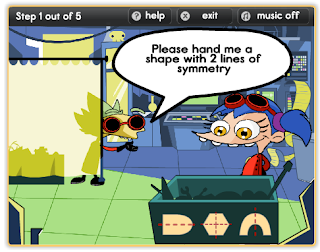 There was basic interaction that the user would make, which is choosing the correct shape to move on to the next question. However the game does not tell you why you got the answer right or wrong it merely sends you to the next question or simply repeats it again.
Goals
The two goals within the game are to get the answer right to move onwards and to reveal what is behind the curtain to complete the game. This can give the child playing a sense of satisfaction when the robot is made and shown to the user at the end of the game.
Struggle
Struggle within the game is not a huge thing as the game is pretty basic and only allows the user to pick 1 out of a possible 3 shapes, this can however be struggling if the child does not know the correct shape and would have to figure out the correct answer.
Structure
Again with the structure of the game, it is basic as you choose a shape and that can either advance you through the game or reset the question so you can have another go.
Endogenous Meaning
There can be an endogenous meaning to the game as there can be knowledge taken from it, such as the amount of the sides to certain shapes or what the line of symmetry for the shape is. Once the game is completed however the robot does not mean anything in reality and has no meaning.
Evaluation
The game isn't the best in the world but for an educational game its ok but there are some improvements which can be added, such as having a mini game involving the robot which the user creates during the game so they have a sense of achievement. There could also be a point scoring system where the user gets a 3 points for getting the answer correct the first time, 2 for the second and obviously 1 for the third time. These points could add to the sense of competition which could arise if there are a group of children playing in the class room or it could allow a mini game or special video at the end to show they have completed the game with maximum points. Overall its a pretty basic and easy game for a keystage 1 child but as above there are some improvements which would certain teach the child more.
I should have another review coming soon!
Interaction
 There was basic interaction that the user would make, which is choosing the correct shape to move on to the next question. However the game does not tell you why you got the answer right or wrong it merely sends you to the next question or simply repeats it again.
 Goals
The two goals within the game are to get the answer right to move onwards and to reveal what is behind the curtain to complete the game. This can give the child playing a sense of satisfaction when the robot is made and shown to the user at the end of the game.
Struggle
Struggle within the game is not a huge thing as the game is pretty basic and only allows the user to pick 1 out of a possible 3 shapes, this can however be struggling if the child does not know the correct shape and would have to figure out the correct answer.
Structure
Again with the structure of the game, it is basic as you choose a shape and that can either advance you through the game or reset the question so you can have another go.
Endogenous Meaning
There can be an endogenous meaning to the game as there can be knowledge taken from it, such as the amount of the sides to certain shapes or what the line of symmetry for the shape is. Once the game is completed however the robot does not mean anything in reality and has no meaning.
Evaluation
The game isn't the best in the world but for an educational game its ok but there are some improvements which can be added, such as having a mini game involving the robot which the user creates during the game so they have a sense of achievement. There could also be a point scoring system where the user gets a 3 points for getting the answer correct the first time, 2 for the second and obviously 1 for the third time. These points could add to the sense of competition which could arise if there are a group of children playing in the class room or it could allow a mini game or special video at the end to show they have completed the game with maximum points. Overall its a pretty basic and easy game for a keystage 1 child but as above there are some improvements which would certain teach the child more.
I should have another review coming soon!
Sunday, 3 October 2010
Can a board game be as entertaining as the latest video game?
More and more people are becoming involved with games particularly video games with the latest consoles such as PS3, Xbox 360, Nintendo Wii and the various portable consoles, but can the old school board games be as much fun for example the latest Fifa game or the brand new Call of Duty?
Well I believe that board games have unique mechanics and perspectives which video games don't have, such as the excitment of buying a whole set of houses on monopoly and watching your family and friends give away all there money, slowly winning you the game. Monopoly is certainly one of the biggest selling board game of all time and all it's made up of is a few people moving around buying houses, which everyone seemed to love years ago before the likes of the Nintendo Wii and various other new gen consoles provided digital entertainment. Ever since video games have become easier to buy and play within the household the market for board games has slowly decreased, most family may only play board games during the odd holiday such as Christmas, Easter etc... In my opinion video games have become easier to just pick up and play from and 5 year old child to a 65 year old pensioner along with the fact they constantly change and provide more visual entertainment for perhaps a few members of the family.
 Board games can also cater for any age not forgetting card games too, a simple game of Pay Day or Monopoly for example can go on for hours on end with everyone gripped into the game and not noticing how long they have been playing. This can happen for some video games but most of the time the whole family cannot sit down and be so deeply involved for a fair few hours playing the same game, maybe the Wii and possible now as Kinect and Playstation Move have been released it could be possible but for the entire family to be so excited about these latest inventions for the console gamer. Well I think not, board games will take a hard beating and for the time being nothing can match a board game, some people may prefer Fifa 11, Sims 3, Football Manager MW2 etc... but i very much everyone likes them and they are not a very family friendly game. In my own personal opinion I would very much prefer to play the latest video game but won't usually say no to a game of Dingbats, Monopoly and such. Some big names have made it on to the famous board game from the video game sector such as the Mario world, this shows board games haven't lost that edge and are still a decent means of entertainment. Its really a matter of personal opinion of the people playing but I just don't think board games have been beaten just yet. I hope you enjoyed reading my post and i hope to add more in the near future about some games i play as well as some thing i do such as attend performances, review games and many more
Andre Bolton
Well I believe that board games have unique mechanics and perspectives which video games don't have, such as the excitment of buying a whole set of houses on monopoly and watching your family and friends give away all there money, slowly winning you the game. Monopoly is certainly one of the biggest selling board game of all time and all it's made up of is a few people moving around buying houses, which everyone seemed to love years ago before the likes of the Nintendo Wii and various other new gen consoles provided digital entertainment. Ever since video games have become easier to buy and play within the household the market for board games has slowly decreased, most family may only play board games during the odd holiday such as Christmas, Easter etc... In my opinion video games have become easier to just pick up and play from and 5 year old child to a 65 year old pensioner along with the fact they constantly change and provide more visual entertainment for perhaps a few members of the family.

Andre Bolton
Thursday, 30 September 2010
Introduction to Critical Games Studies - The Interview! :-)
Hello! I'm Andre and just started to study Computer Games Design and was asked to set up a blog to track my activities and so i can try and get more inspiration as well as trying to become more aware of movies, art galleries and other means of finding inspiration for the games i will help to design in the near future. The module which we set this up was Critical Games Studies and we were asked to kick the blog off with a few simple interview questions to find a little bit about another student on the course. The Questions I was asked are bellow along with my answers enjoy! =)
Interview Questions-
What is the title of the book (fiction) you are currently reading (or the last fiction book you read)? To some this may be a bit geeky but heck its Star Wars: The adventures of Darth Maul :P. Its a novel where you follow the escapades of the Sith lord before he met his match in Episode One of the famous move series. Nevertheless i am not a "book worm" and have been reading this book on and off for about a year but I am still determined to finish it no matter what!
What is the title/topic of the book (non-fiction) you are currently reading (or the last non-fiction you read)? I don't tend to read many book fiction or fact but i recently picked up the new QI : Quite Interesting book which is full of fascinating facts and statistics about near enough anything you can think of. I thoroughly recommend it to anyone who likes the program or just reading about facts and other interesting pieces of information.
What is the last live performance (music, drama or dance) you attended?
I'm not the type of person to attend these type of performances but i will be looking into going to some in the near future. I personally would like to become more involved and interested in going to see some of these performances as they could prove to be a good source of inspiration for my designs.
What is the title of the last film you saw at the cinema / or online or watched on dvd?
The last film i saw was 300 which was on TV Sunday 26th September 2010 which was excellent as always, i have seen it about 3-4 times now and the whole feel of the movie and the story gets better and better. I tend not to watch too my TV as i used to as i spend more time on my PC than i ever did before, I occasionally go to the cinema to watch the latest releases if they particularly look exciting. Ever since i have got my computer which has a blu-ray in i seem to watch movies on that as they are all in glorious HD, my blu-ray collection may still be a bit on the small side but hopefully it will forever increase.
How often do you read a newspaper? (Which one)?
Yet again im not the type of person to read newspapers that much but my dad tends to do so and he gets the East Anglian Daily Times and The infamous The Sun newspaper. I pick these up when they are in the house and have a read but i am not an avid reader so I don't go out and buy them.
Which art gallery / museum / exhibition did you last visit?
As with the live performances i am not one to attend these events but will be looking to visit some events in the near future.
How many hours a week do you spend playing video games?
I spend a fair bit of my time playing games on my PC as I am an old school gamer and not a real fan of the consoles, i spend most my times playing games on steam and that is about 35 hours a week i feel that isn't a great deal but still isn't too much and im satisfied that I get enough from what I am playing at the time. I am really into any type of game i feel like playing weather it be the new Football Manager game or the latest Call of duty, as i said i play most of my games on the pc so i tend to stick with strategy and fps more but I am always open to playing any game.
How many hours a week do you spend playing games other than video games?
I don't really play games other than video games too much but I may pick up a pack of cards and have a game with someone but nothing major certainly less than 1 hour a week. Everyone in our house used to like board games but since we have computers all over the place it seems that we barely play at all maybe the traditional game at Christmas or Easter apart from that they gather dust in the cupboard as well as most of the countries board games i assume.
Interview Questions-
What is the title of the book (fiction) you are currently reading (or the last fiction book you read)? To some this may be a bit geeky but heck its Star Wars: The adventures of Darth Maul :P. Its a novel where you follow the escapades of the Sith lord before he met his match in Episode One of the famous move series. Nevertheless i am not a "book worm" and have been reading this book on and off for about a year but I am still determined to finish it no matter what!
What is the title/topic of the book (non-fiction) you are currently reading (or the last non-fiction you read)? I don't tend to read many book fiction or fact but i recently picked up the new QI : Quite Interesting book which is full of fascinating facts and statistics about near enough anything you can think of. I thoroughly recommend it to anyone who likes the program or just reading about facts and other interesting pieces of information.
What is the last live performance (music, drama or dance) you attended?
I'm not the type of person to attend these type of performances but i will be looking into going to some in the near future. I personally would like to become more involved and interested in going to see some of these performances as they could prove to be a good source of inspiration for my designs.
What is the title of the last film you saw at the cinema / or online or watched on dvd?
The last film i saw was 300 which was on TV Sunday 26th September 2010 which was excellent as always, i have seen it about 3-4 times now and the whole feel of the movie and the story gets better and better. I tend not to watch too my TV as i used to as i spend more time on my PC than i ever did before, I occasionally go to the cinema to watch the latest releases if they particularly look exciting. Ever since i have got my computer which has a blu-ray in i seem to watch movies on that as they are all in glorious HD, my blu-ray collection may still be a bit on the small side but hopefully it will forever increase.
How often do you read a newspaper? (Which one)?
Yet again im not the type of person to read newspapers that much but my dad tends to do so and he gets the East Anglian Daily Times and The infamous The Sun newspaper. I pick these up when they are in the house and have a read but i am not an avid reader so I don't go out and buy them.
Which art gallery / museum / exhibition did you last visit?
As with the live performances i am not one to attend these events but will be looking to visit some events in the near future.
How many hours a week do you spend playing video games?
I spend a fair bit of my time playing games on my PC as I am an old school gamer and not a real fan of the consoles, i spend most my times playing games on steam and that is about 35 hours a week i feel that isn't a great deal but still isn't too much and im satisfied that I get enough from what I am playing at the time. I am really into any type of game i feel like playing weather it be the new Football Manager game or the latest Call of duty, as i said i play most of my games on the pc so i tend to stick with strategy and fps more but I am always open to playing any game.
How many hours a week do you spend playing games other than video games?
I don't really play games other than video games too much but I may pick up a pack of cards and have a game with someone but nothing major certainly less than 1 hour a week. Everyone in our house used to like board games but since we have computers all over the place it seems that we barely play at all maybe the traditional game at Christmas or Easter apart from that they gather dust in the cupboard as well as most of the countries board games i assume.
Subscribe to:
Comments (Atom)